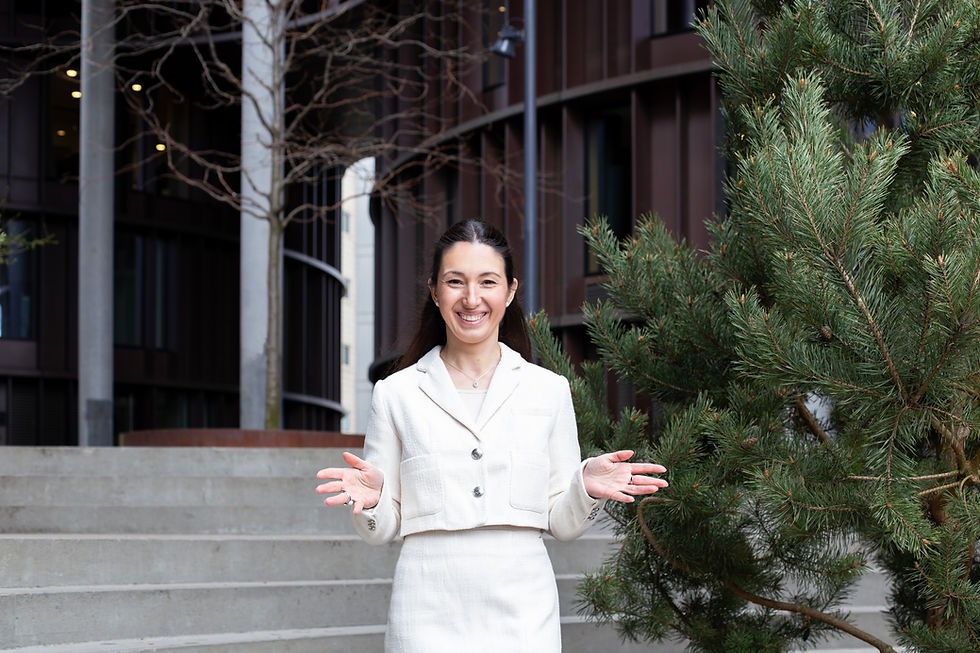
Stepping forward on and off the catwalk

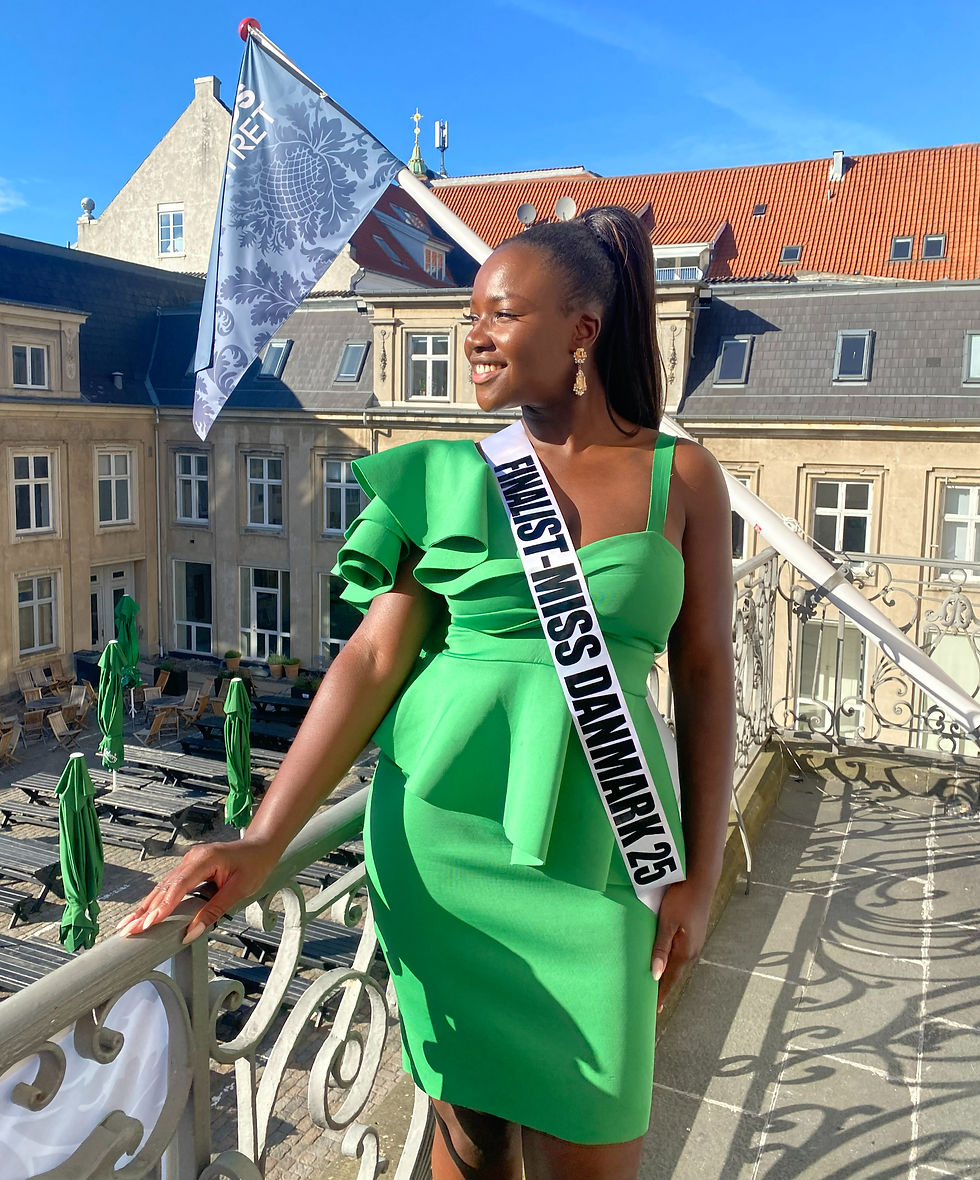
Aminata Andersen, finalist of Miss Denmark 2025 and winner of Miss Congeniality, shares
how growing up between cultures shaped her identity and values. From pageantry to global
business and community-building, she transforms challenges into confidence and connection.
Photographs: Various
Text: Maja Cawthra
Aminata, who describes herself as an “Afro-Danish woman,” was born in Denmark to a Senegalese mother and a Malawian father and was later raised by her mother and her Senegalese stepfather. She grew up in a home where cultures overlapped rather than competed. Both her mother and stepfather worked in professional kitchens, so food played a central role in creating a home that was a gathering place for friends and family. Here, both West African dishes and Danish meals were enjoyed. Hospitality was not something reserved for special occasions. It was a daily practice.
“I was raised to be open and proud of my background. I never hesitated to bring friends home. In fact, my parents preferred that I invite friends over rather than spend time elsewhere. They wanted me to feel proud of where I came from and never ashamed to share my culture with my Danish friends.”
Between cultures: From doubt to freedom
At the same time, her upbringing highlighted small but persistent differences that set her apart from her peers. As the eldest of three siblings, responsibility came early.
“From first grade, I would shop for groceries, prepare my own lunch, pick up my younger siblings, and help clean before going out to play. Today, I am deeply grateful for that independence and responsibility. At the time, however, it was not something I felt proud to share, because most children in my neighbourhood did not have those same duties.”
This also led to moments where Aminata would question whether she was ‘Danish’ enough. She does not look like a ‘typical’ Dane, and for a while she wondered how much that mattered. Over time, she was able to let that go. She couldn’t change it, nor should she. Rather than trying to fit into one culture, Aminata sees her sense of existing between cultures as a strength.
“I have learned to see it not as confusion, but as freedom.”
From this found freedom, her appreciation for Danish culture deepened. For Aminata, being Danish is not about appearance, but about attitude. She values the cultural tendency not to take oneself too seriously, and she feels that both Danish humour and music capture this understated honesty.
“Danish may not be considered the richest language in the world, but in my opinion, that very simplicity calls for creativity and the ability to say a lot with fewer words. Many Danish songs succeed beautifully in doing that.”
Burnout and an unexpected opportunity
Learning to see that in-between space as freedom did not mean the path forward was easy.
After finishing business school, Aminata threw herself into work with the same sense of responsibility that shaped her childhood. She joined a residential community project that she cared so deeply about, “you would think I had founded it myself.” Gradually, that commitment became too much to bear. She was giving more than she had. Concentration slipped. Sleep disappeared. She had to stop.
It was in those moments of quiet recovery, where her body began to settle, and her thoughts cleared, that she came across a Facebook advertisement for Miss Denmark. Miss Denmark has been Denmark’s national beauty pageant since 1926. It was not until Aminata received an email inviting her to participate that she remembered having received the same invitation at 18. Still unable to pay the casting fee, she let the opportunity go. This time, she didn’t.
More than beauty: The work behind pageantry
Many people have a shallow understanding of the world of pageantry. Sure, looks play a big role, but there is more to it beneath the surface.
“Pageantry requires meaningful engagement with societal issues or personal projects. I reconnected with the mother of a school friend to support her organisation, helping set up tables for free community dinners and distribute groceries at Christmas. If you multiply that kind of effort by 29 finalists each year, the collective impact becomes significant.”
Not only are these women engaged in their communities, but it is also, quite simply, a lot of work.
“The final show is only the visible result. Before that, there were countless makeup tests to refine our skills, catwalk training, dance classes, early mornings starting at 4 or 5 AM for glam, and evenings spent preparing outfits for the next day.”
Aminata often described pageantry as a sport, a comparison that was very intentional on her part, as she wanted people to see the discipline and physical training that go into pageantry alongside the community service it supports. She believes that how you communicate your passions shapes how they are received, and this reinterpretation was met positively by those around her.
“Pageantry is often seen as superficial. But it is one of the most confronting mirrors I have ever stood in front of. It magnifies everything.”
"I was raised to be open and proud of my background… They wanted me to feel proud of where I came from and never ashamed to share my culture with my Danish friends."

A pleasant surprise of recognition
As an Afro-Dane, Aminata did have some worries about whether she would be accepted or treated differently as a Black woman in a predominantly white society. Her experience exceeded her expectations.
“I received thoughtful advice on how to style my braids, and at the finale, we had professional hairstylists, including a stylist of colour who understood textured hair. It may sound small, but for many African women living in Western countries, hair is a sensitive and meaningful topic. Our hair responds differently to products and styles, and it requires both skill and understanding — especially given the historical perceptions of Black hair.”
She acknowledges that while her participation does not erase larger structural racism, she views the experience as a meaningful signal of change and cultural understanding. And allowed her to recognise and appreciate qualities in herself that she had not fully acknowledged before.
“Even on days when I do not feel my best, I can remind myself of my worth. Perhaps it took someone seeing me as eligible for a beauty pageant to spark that shift, but I am not ashamed of that. I know that my personality played a role in being chosen, and that realisation strengthened my confidence.”
Miss Congeniality and community
While Aminata did not win the overall competition, she did win Miss Congeniality. This award is given to contestants who demonstrate friendliness, kindness, and a positive attitude and is voted for by the other contestants - a high honour.
Winning Miss Congeniality moved Aminata more than any title could have. It felt personal and earned. The pageant had awakened something familiar — the life she had built around gathering people, from her childhood through her professional life, creating spaces and holding conversations that mattered.
This inspired Aminata to create a community of her own, forming Momentum Community, a space centred on growth, strength, and connection and living ‘consciously’.

From pageantry to global business
The lessons Aminata learnt through pageantry carried into her professional life as a businesswoman. Currently working as an Office & Community Coordinator at Bjarke Ingels Group, Aminata operates in a global environment shaped by cultural nuance and collaboration, where her perceived differences are once assets, shaping how she communicates, negotiates, and leads.
“My mother moved to Denmark at a young age, learned the language, and completed her education while raising me. Watching her navigate a new system shaped my understanding of resilience and adaptation. That compassion translates directly into my work, especially when collaborating with expats and international colleagues.”
In many ways, pageantry mimicked the business world, but in a way that made Aminata and other womenvisible and at the forefront.
“I learned that the pageant world is full of ambitious students and businesswomen, which does not surprise me after having gone through the process. You have to show that you are passionate and driven about something. It is also necessary to be able to promote yourself, find sponsors, and balance the budget for participation, clothing, and travel. In that aspect, it makes sense that most pageants are supportive of business-minded women.”
Working in business taught Aminata that you only receive what you are willing to ask for. Goals do not move on their own. You have to define them. Build a plan. Communicate clearly. In business, initiative is not optional.
Pageantry taught her something different but perhaps even more crucial in life: to trust her voice. To project her dreams into the world without constantly second-guessing herself. Not in a naïve or magical way, but through believing in herself, and taking courage and action.
Together, these two (seemingly) different worlds shaped a strong, quieter confidence. The kind that does not need to be loud to be heard, but one that allows her to move between cultures, industries, and expectations without shrinking.

A consistent thread
Aminata’s story, from a culturally rich childhood to beauty pageants and work in global business environments, is hard to define, but it reflects a consistent thread of discipline and community. While many people see pageantry as a competition of vanity, Aminata saw the resilience and female solidarity. The women she met were ambitious, hardworking, and passionate, qualities that continue to drive her personal and professional life.
“If you had asked me whether I wanted to walk on a big stage in front of hundreds of people, with even more watching online, I would have said no. It did not sound like me. But I trusted that the Miss Denmark process would challenge me and reveal undiscovered sides of myself. Those few moments on the catwalk became some of the most powerful experiences of my life. Putting yourself out there is scary. But if you trust yourself and allow yourself to enjoy the process, you will not regret it.”
Find Aminata on Instagram: https://www.instagram.com/amichikondi/

Picture courtesy of: Aminata Andersen Picture courtesy of: Aminata Andersen