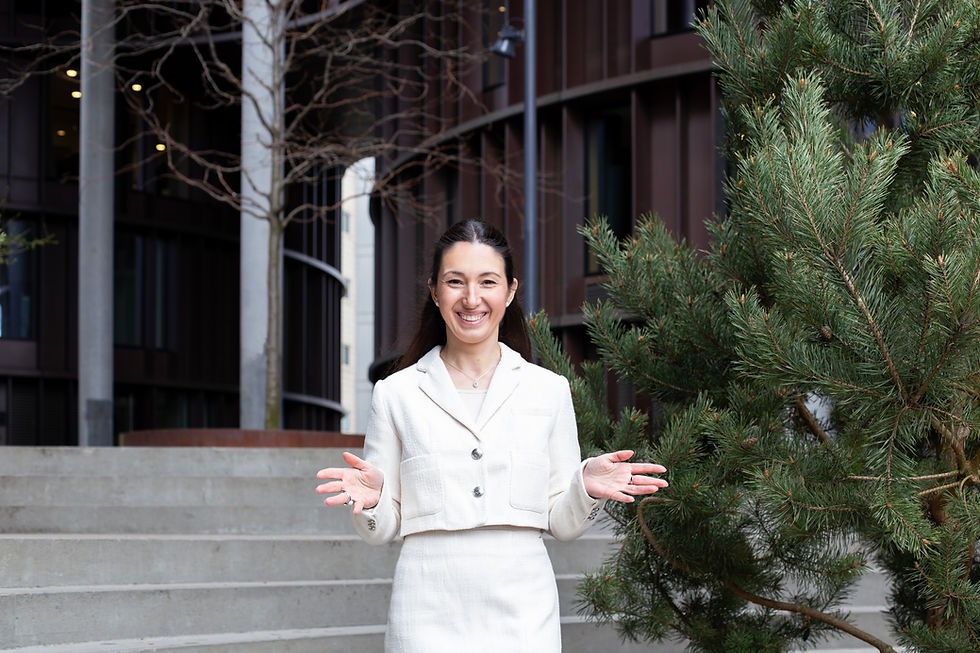
Raised global: Connecting borders

Having grown up across six countries, Thorbern Alexander Pangilinan Klingert has always lived within an intersection of cultures and international politics. Now, Klingert works as a senior consultant while also pursuing a political career, including running for the Danish Parliament in the 2026 election.
Photographs: Maja de Silva
Text: Maja Cawthra
With a Danish father and a Filipino mother, born in Switzerland and spending his adolescence in Greece, Thorbern Alexander Pangilinan Klingert has never viewed the world through a single national lens. Instead, he describes himself as a ‘third-culture kid’. This term refers to groups of children who spend the majority of their formative years in a culture and environment different from those of their parents, a growing phenomenon in the globalised world. For this reason, ‘home’ for Klingert was less a place than something more emotional.
“Because we moved and lived in different countries, home became the feeling of being with family, the values you carry with you, and the relationships you build. Looking back, I think that experience shaped how I see the world: not as separate national boxes, but as a network of cultures that can coexist and enrich each other.” This mindset remains at the forefront of Klingert’s life. Growing up across borders and cultures meant Klingert was constantly exposed to different ways of thinking, living and relating to people.
“It taught me early on that people can have very different perspectives depending on their history, economic circumstances, and cultural traditions,” he explains. “At the same time, it also made me appreciate how interconnected we all are.” This also applied to his own identity, while he ‘feels’ Danish and Filipino, Klingert is also shaped by the communities and places he has been a part of.
Living in the ‘in-between’
Yet this layered identity has not always been straightforward. Like many who grow up internationally, Klingert lives in these ‘in-between’ spaces, existing between cultures rather than fully inside one.
“You sometimes feel slightly different wherever you are - not entirely local, but also not entirely foreign.” This uncertainty, while at first can be viewed as a hindrance or isolating, Klingert began to view it as an asset.
Living between cultures taught him how to adapt and navigate different perspectives with care. Over time, what once felt like an in-between space transformed into something far more valuable. “You can belong to more than one place,” he reflects. “And that can be a powerful bridge between cultures. It has made me strongly value openness, cooperation, and dialogue between countries and cultures.”

From perspective to practice
As he moved between countries, this sense of in-betweenness began to play out in everyday life - whether it was navigating different school systems, adjusting to new social norms, or hearing debates discussed in completely different ways - Klingert began to view them as something constructive. His background taught him how to listen carefully, ask questions, and find common ground across perspectives.
“When you grow up across borders, you see firsthand how interconnected societies are, economically, politically, and culturally. That experience has shaped my belief that international cooperation is not just an abstract political idea, but something very practical that improves people’s lives.”
Crises that made it real
Spending his adolescence in Greece during the height of the euro crisis brought these ideas into sharp focus. “Living in Greece during the euro crisis was a formative experience. I remember the public conversations about austerity, unemployment, and the future of the European project. There was a sense that people were grappling with very real economic pressures while also questioning broader political structures. What stayed with me most was how deeply economic decisions at a European level could affect people’s everyday lives. It gave me a much more human understanding of economic policy and of the importance of solidarity and cooperation within Europe.”
After Greece, Klingert moved to London to study, drawn to the cultural hub and the international environment. “London is a city where people from all over the world come together, and it was an exciting place to continue growing academically and professionally. For someone with an international background, it felt like a natural next step.” In London, he also experienced the Brexit referendum from within.
“The debate was everywhere - in universities, workplaces, and everyday conversations. For many people with international backgrounds, including myself, the vote felt deeply personal because it raised questions about openness, identity, and Europe’s future. I fundamentally disagreed with the decision to leave the European Union, and witnessing that shift firsthand reinforced my belief that our future lies in cooperation, not isolation.”
"The real strength of a society lies in its ability to welcome different perspectives and turn them into something shared."

From awareness to action
It was his childhood and these crucial experiences that transformed his awareness into an evolved interest in politics. While Klingert jokes that the singular moment was when, as a young boy, he wanted to be president, it is more accurate to say that his interest stemmed from an increasing understanding of how politics shape everyone's everyday reality. Living in different countries meant being exposed to a range of political systems and societal challenges. “I became more interested in how political decisions affect communities, especially in an increasingly interconnected world,” he explains. “That curiosity eventually grew into a desire not just to observe politics, but to participate in it actively.”
After living abroad for many years, Klingert felt a strong responsibility to return to Denmark and contribute to the society that helped shape him. Believing also that if he were not to return, he would risk losing his connection with Denmark. These feelings were also amplified by personal reasons, such as his grandmother’s health at the time and Brexit. “Having lived through that process in England, I felt increasingly drawn toward being in a country that didn’t question its commitment to European cooperation.” It was here that Klingert’s interest in participating in politics became a tangible reality.
An international voice in Danish politics
Being a member of the Venstre (Liberal Party) party since 2020 - including previously standing as a candidate in the 2024 European Parliament elections and currently running for the Danish Parliament - Klingert has a special focus on the international community in his campaigns.
He believes his experiences abroad have given him a broader understanding of how Denmark fits into the wider, global context, bringing different questions and ideas into the political conversation. Defining himself as an internationalist, Klingert believes that countries are stronger when they cooperate rather than isolate themselves. For him, being an internationalist means: “Supporting institutions and policies that encourage dialogue, shared solutions, and cross-border collaboration. In practical terms, it also means advocating for policies that recognise the realities of a globalised world - where people, ideas, and economies are interconnected.”
Klingert deeply respects Denmark's strong tradition of civic participation and trust in democratic institutions. “There is a sense that citizens can engage with politics and that their voices matter. That culture of participation inspired me to become more involved myself.” But not everyone is aware they have a voice.
“The international community is an increasingly important part of Danish society. Many internationals live, work, study, and build families here, yet they are sometimes not fully aware of their rights or opportunities to participate in civic life.”

Bridging the local and the global
Advocating for greater awareness of voting rights for internationals in the local Danish elections is something Klingert spends a lot of time on, such as hosting events and participating in ones, like the International Citizens’ Days (an event in the heart of Copenhagen that provides guidance and meaningful connections for new and old internationals). “For me, democracy works best when everyone eligible to vote is made aware that they have a voice.”
Focusing on the international community comes with its own set of unique challenges, namely the challenge of relatability. “International perspectives can sometimes feel abstract in domestic political debates. It takes effort to connect global issues with the everyday concerns people experience locally.” However, it can also be rewarding to build bridges and help people understand how international cooperation benefits Denmark.
The steps forward
As Klingert continues his path into politics, his focus remains shaped by the experiences that defined his upbringing: living across countries, adapting to new environments, and seeing how decisions made at one level affect people on the ground.
“Denmark is a remarkable country, but like any society, it can sometimes take time for newcomers to find their place fully. My message to the international community is to stay engaged, participate, and help shape the society you are part of.” These steps can be taken concretely, such as voting when eligible, taking part in local discussions, and spreading awareness.
At the same time, he stresses that responsibility and connection do not lie solely with internationals. “To Danes, I would say that openness and international cooperation have long been strengths of our country. In an increasingly interconnected world, continuing to embrace those values will help ensure that the best is still yet to come. Having grown up between cultures, I’ve learned that identity doesn’t have to be confined to one place,” he says. “The real strength of a society comes from its ability to welcome different perspectives and turn them into something shared.”
As he looks ahead to the next stage of his political career, that approach remains central: making international perspectives more understandable in a Danish context, and encouraging more people - both Danish and international - to take part in the society they are already a part of.
and X.