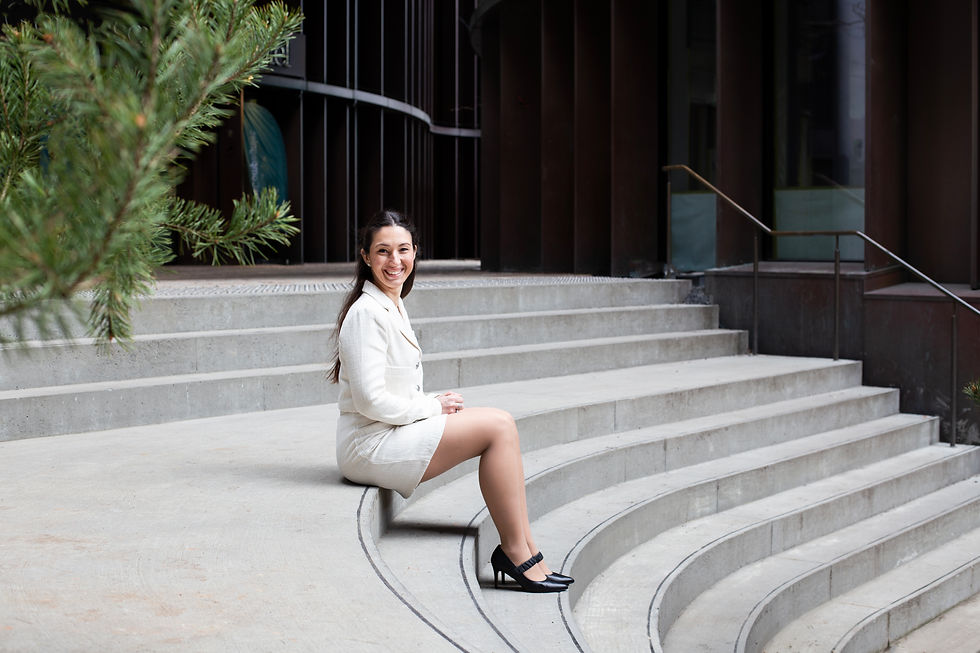
Building a life - one step at a time

Having grown up in several countries across Europe, Diana Medrea-Mongensen has long navigated life between cultures. Now based in Denmark, she is the founder of We Are Entrepreneurs, a support organisation helping people build their own businesses, reflecting on her own journey from struggling to enter the Danish job market to creating and selling her first company while raising two children in a multicultural environment.
Photographs: Maja de Silva
Text: Viggo Goris
Being born in Romania and moving to Spain at an early age meant that adapting to new environments came almost naturally to Diana. Each country brought different languages, expectations, and ways of life, gradually shaping a mindset rooted in flexibility and observation.
“I was already quite flexible in being away and finding a place for myself,” she explains. That sense of mobility, however, did not mean that every transition was seamless. While moving had always been part of her life, Denmark challenged her assumptions in ways she had not anticipated.
“I expected it to be a lot more similar to the other places that I lived.” Instead, she encountered a society that felt markedly different, more reserved, less accessible, and harder to navigate as an outsider than she had imagined.
For the first time, adaptability alone did not guarantee opportunity. “Coming to Denmark and actually being faced with the possibility that you might actually not be able to get a job was shocking to me,” she says. Before arriving, employment had never been a concern. Work had always been available, even if it meant moving or adjusting roles. In Denmark, that certainty disappeared.
Arriving during the aftermath of the financial crisis of the early 2010s, only made the challenge more difficult. Companies were firing people rather than hiring them. “I did look for a job, but without success, so I became restless.” This experience is one many internationals in Denmark recognise: the moment when qualifications and motivation do not translate into access. For Diana, this restlessness became a turning point.
From uncertainty to creation
Faced with limited options, she began exploring alternatives, initially without a clear intention to build a business. “I started cooking and baking and had a blog for it that became very popular.” As a result of her growing popularity, requests followed, and people started ordering cakes.
The shift from a hobby to a business happened step by step. Rather than launching a structured company, she focused on understanding each step as it came. “We looked into how we could formalise the concept and what kind of processes we needed to understand to have a food business in Denmark.”
Diana sought out local courses, accessed small business support programmes, and worked with consultants where possible. “I went to some courses there and managed to get some grants. And slowly, I started to build a working business.”
The business grew naturally, supported by returning customers and word-of-mouth recommendations. It became sustainable but also demanding. At the time, she did not see herself within the traditional definition of entrepreneurship. “I really didn't consider myself entrepreneurial until very recently,” she admits.

Redefining entrepreneurship
Her experience challenged how entrepreneurship was defined in the environments she encountered. “They would ask me if I'm an entrepreneur and then, over and over again, they would tell me: ‘You're not an entrepreneur; you’re just a small business owner.’”
The contrast often came down to scale or industry, particularly the idea that entrepreneurship was tied to innovation in specific sectors. “I was so puzzled, like, what's the difference? Why is my innovation less important than your innovation?” That question stayed with her and gradually evolved into a broader perspective. For her, the work itself already involved creativity, problem-solving, and development.
“We are all entrepreneurs, it doesn't matter what kind of business you have, because we're all solving some sort of problem.” This reframing would later become central to her work and philosophy.
After four years, she decided to sell her business. Not because it was failing, but because it had reached a limit. “It was either sell it or close it. I developed it to the best of my abilities. I couldn't figure out what the next step was.”
At the same time, her personal life was changing. She was about to become a mother and wanted to go back to university to study business. “I couldn't see myself studying, being a new mom, and running the business successfully.” So, the decision to step away was both practical and reflective. It marked a change in her life, allowing her to learn the theoretical side of what she had already experienced in practice.
After completing her studies, Diana returned to an idea that had been developing throughout her journey. “I knew that I wanted to help others to do what I did. And I knew I could because I had the experience.” This led to the creation of We Are Entrepreneurs, an organisation designed to support people who want to start their own businesses.
“We're not a consultancy,” she explains. “We want to help people through education. We also want our programmes to be free to be able to reach as many people as possible.”
“The focus is on accessibility and inclusion, because a person who has the money can always get a consultant. But there are a lot of people who could benefit from the support, but don’t have the money to pay for it.” Through courses, mentoring, and community activities, the organisation provides practical guidance and a sense of direction. “Some people want to do so much, but sometimes they don't do it because they don't know where to start.”
Raising kids across cultures
Alongside her professional work, Diana is raising two children in Denmark, navigating what it means to build a multicultural family while sometimes being far from other family members. “At home, we spoke Spanish with the children and Danish as the outside language.” Her children now speak both fluently, switching between languages depending on context. But beyond language, there is a broader question that many international parents face.
“A lot of parents have this feeling that their kids are missing out, missing out on certain tastes, on family time with relatives.” But Diana looks at it from a different perspective. “Kids cannot miss something they don't know.” Rather than focusing on what might be absent, she emphasises what is being created. “The things that are happening at home here in Denmark are going to be their childhoods.”
Each summer, Diana and her children spend time with her parents in Spain, building connections and experiences that enrich their lives in Denmark. She makes sure to send them to summer school so they can truly engage in the local culture, rather than it just being a summer holiday. But these are not attempts to recreate her own upbringing; they are part of a new one.
"You are the CEO of your life. Try to pick the fights that you want to pick, because otherwise you wake up one day, and you don't recognise whose life you're living."

A life of problem-solving
Diana’s approach to life and work is defined less by long-term planning and more by continuous adaptation. “I just know that I need to fix the problem that I have in front of me.” This mindset has guided her at every stage of her journey, from building her first business to navigating uncertainty during the pandemic. “Every time I solve a problem, there will be a next one to solve.”
When COVID-19 hit shortly after launching We Are Entrepreneurs, she was forced to adapt quickly. But by shifting focus and exploring funding opportunities, she was able to sustain and grow her work.
When reflecting on her journey, Diana does not focus on specific achievements. “I wish I had spent more time thinking about that,” she admits. Instead, she focuses on the process itself. “I don't do things for the result, I just know that I need to fix these things that I have in front of me.”
Still, one element stands out. “I managed to do what I wanted, what I felt like was the right thing to do.” However, that choice comes with challenges. “I know it would be a hard life, a busy life, and I'm very tired.” But it also comes with a sense of ownership and fulfilment. “I’m not living a life where I can't wait for the holidays.”
When asked about advice, Diana is cautious. “I’m always very careful with giving advice because people's circumstances are so different.” Her own experience has been shaped by specific conditions, access to information, support systems, and the ability to stay in Denmark without visa restrictions.
Still, one idea remains central. “Try to pick the fights that you want to pick.” Because without that awareness, it is easy to follow a path that does not feel personal. “You wake up one day, and you don't recognise whose life you're living because it doesn't feel like yours.”
As Diana continues her work in Denmark, her focus remains on creating opportunities not just for herself, but for others navigating similar challenges.
Her journey reflects a broader experience shared by many internationals: adapting to systems that are not always designed for them and finding ways to build within those limitations.
At the same time, it offers a different perspective, one where limitations become starting points, and where entrepreneurship is not defined by scale or industry, but by the act of creating something of your own.
“You are the CEO of your life,” she says. And in that idea lies the essence of her work: not just building businesses but helping others recognise their ability to shape the direction of their own lives.
To follow Diana's work, connect with her on LinkedIn and Instagram via We Are Entrepreneurs.