


Where the past inspires the present
- The International
- Dec 11, 2025
- 3 min read
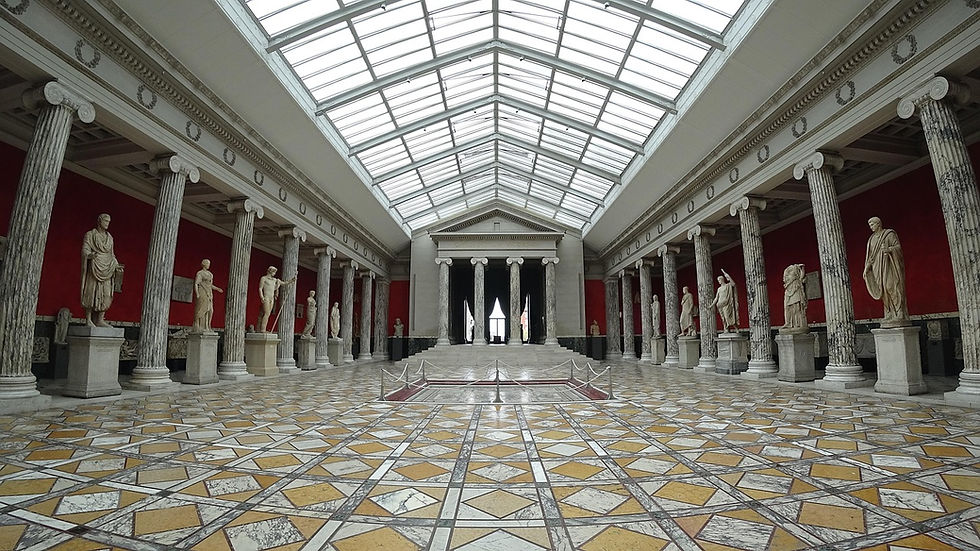
Jess Hearne reveals Copenhagen’s architectural ode to creativity: a museum where humanity meets itself.
Photographs: softcodex- Pixabay
Text: Jess Hearne
For thousands of years, long before cities rose or languages developed, art has captivated and united humanity. Some of the earliest documented forms of self-expression were carved figures and painted wall stories. Glyptoteket, a sanctuary of artistic delight in the heart of the capital that blends past and present, offers visitors a chance to immerse themselves in creativity and reconnect with what really matters.
An architecturally magnificent setting
Glyptoteket began with the philanthropy of Carl Jacobsen, who is famed for transforming the Carlsberg brewery into the iconic brand it is today. Despite being a shrewd and visionary businessman, his real passion was creativity, believing that art enriched people’s lives and should therefore be accessible to everyone.
An enthusiastic collector, Jacobsen accumulated an impressive array of pieces from all corners of the globe. His main passions lay in the art of Ancient Greece and antiquity, but he also had an interest in works from France and Denmark. By 1885, his private villa was officially open to the public, and the collection had expanded to19 galleries. Despite footing the bill for multiple expansions of the original building, it became clear that his ever-growing collection needed a new home.
On 8th March 1888, Jacobsen donated his beloved treasures to the Danish State and the City of Copenhagen, on the condition that they be placed in a suitable new location easily accessible to the general public. Despite hoping for a spot in the newly-built Rådhusplads, Jacobsen accepted the proposed spot on the western ramparts of the city, where it still stands to this day. Inspired by Ludwig I’s Glyptothek in Munich, Jacobsen chose a similar name for his own museum, combining the Greek words glyptos (carving or sculpting) and theke (a place where something is collected or displayed). His vision was to build a temple of beauty in which art could speak to everyone in an architecturally magnificent setting.
Art within art itself
The building we see today is a piece of art in itself. Inspired by the architecture of the Venetian Renaissance, Vilhelm Dahlerup’s 1897 façade and Winter Garden featured vaulted spaces, a domed glass conservatory and Italian ornament. An extension and rework of the garden were designed and inaugurated by Hack Kampmann in 1906, and, more recently, Henning Larsen Architects added a light-filled contemporary wing marrying the old and the new.
Despite having a deep appreciation of art in all its forms, Jacobsen was particularly passionate about sculpture, believing three-dimensional pieces were the easiest for the average person to relate to. He bought his first classical piece, the Rayet Head, in 1879 and soon added a Roman sarcophagus, some Palmyrene portrait busts, various French statues, and copies of Roman bronze sculptures discovered in the ruins of Pompeii. Jacobsen’s array of sculpture grew to new heights in 1887, when he met the German archaeologist Wolfgang Helbig. For the next 25 years, Helbig served as an on-site agent for Jacobsen in Rome, where he worked tirelessly to secure the vast expanse of Roman antiquities still on display in Glyptoteket's galleries.
Jacobsen was also an admirer of contemporary French art, whose works he saw at the annual exhibitions in Paris. The first French work, La Musique by E. Delaplanche, was added to his collection in 1878, and he acquired a couple of pieces each year thereafter. He was a regular buyer at the Salon de Paris. He commissioned several works directly from his favourite French contemporary artists, including Antonin Mercié’s stunning centrepiece in the museum’s Winter Garden, Gloria Victis.
Today, Glyptoteket houses over 10,000 works of art. Its collections span Greek, Roman, Etruscan, Egyptian and Near Eastern antiquities, major French Impressionist and sculptural works and Danish Golden Age painting and sculpture. There is also an extensive array of European art from Neoclassicism to Modernism, including pieces by Rodin, Degas, Gauguin, Picasso, Miró and Giacometti, as well as notable modern paintings and diverse archaeological treasures.
Ultimately, art reminds us that our sentiments have survived far longer than our achievements; people of the past felt joy, loss, and curiosity just as we do today. Humanity can often feel scattered and divided, yet art lifts us, connects us and reminds us that creativity has shaped our societies as much as any invention or discovery ever has.
To plan your visit, go to https://glyptoteket.com/


