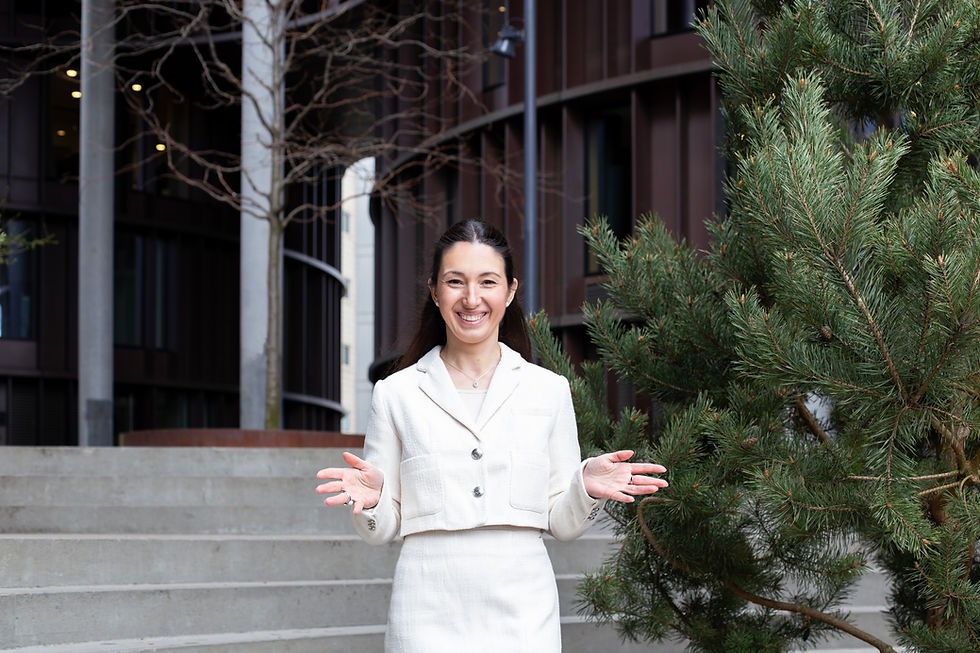
Creative Aurélia: Making colours dance across borders
- The International
- Jan 13
- 7 min read

From the in-between to the centre, artist and writer Aurélia Durand who turned migration into a method - and joy into a language.
Photographs: Various
Text: Lyndsay Jensen
By the time you encounter the work of Aurélia Durand, you often feel it before you fully take it in.
The colours arrive first - bold, energetic, and confident. Then come the figures: bodies in motion, faces open and calm, eyes meeting yours. There is joy here, but it is not surface-level. It feels intentional and lived-in. The images do not ask for attention; they make space. They allow people to exist fully, without explanation.
For Aurélia, that space has always been important. Raised between France and La Réunion, with family roots in Côte d’Ivoire, she learned early on that identity is not something neatly inherited, but something you move through and shape over time. Now based in Copenhagen, she has built an international practice that spans illustration, animation, murals, books, and global campaigns. Across all of it runs the same question: what does it mean to be seen, and who gets to decide what visibility looks like?
Learning to see herself
Aurélia did not set out to make political art. She started by drawing what was missing. As a child, she noticed the absence of images that reflected her skin, her hair, her family, or the joy she experienced within her own world. Drawing became a way to fill those gaps, a way to create images she wished had existed.
What began as something personal slowly revealed itself as something shared. Over time, she realised that many others were looking for the same reflections. Her images didn’t just express identity; they reclaimed it. They offered visibility without asking for justification, and dignity without conditions.
Growing up between different places sharpened this awareness. France brought structure and discipline. La Réunion offered warmth, rhythm, and cultural layering. Her Ivorian heritage carried history, strength, and connection. Rather than trying to merge these influences into a single, fixed identity, Aurélia learned to live comfortably in between them. That sense of fluidity continues to shape her work today.
Absence and abundance
When Aurélia talks about her childhood, she often returns to a contrast between two experiences: absence and abundance. There was the clear lack of representation - a silence that felt heavy. At the same time, there was an abundance of life around her: family gatherings, music, colour, laughter, and movement.
Her work exists in the space between these two realities. It does not deny difficulty or struggle, but it refuses to make them the centre of the story. Instead, Aurélia places joy at the forefront - not as an escape, but as a conscious choice. In a world that often frames Black identity through pain or hardship, her work insists on pride, tenderness, rest, and play.
This approach is closely tied to her use of colour. For Aurélia, colour is not simply decorative. It carries emotion, memory, and meaning. Painting joy is not about avoiding reality; it is about widening it and making room for more truthful, complete stories.

Finding permission
Aurélia’s formal art education took place between France and Denmark, and the contrast between the two environments had a lasting impact. France gave her a strong technical foundation. Denmark gave her something less tangible but just as important: permission.
In Danish classrooms, ideas were valued over polish. Intuition mattered. Simplifying a drawing was not seen as a failure, but as a way of communicating more clearly. For the first time, the way Aurélia naturally worked - once criticised as being “too colourful” or “too simple” - was understood as a strength.
That shift changed her relationship with her work. It allowed her to trust her instincts and recognise consistency where others had once seen excess. She began to understand that finding your voice doesn’t come from fitting into expectations, but from returning again and again to what feels honest.
The move north
Aurélia originally came to Denmark to study, but what made her stay was something quieter. Copenhagen offered space - both physical and mental - to listen to herself. The stillness of the city stood in contrast to the layered noise of her upbringing, creating room for reflection and focus.
At the same time, living in Denmark meant becoming more visible. As an artist of colour, she was often one of very few. That visibility brought moments of isolation and misunderstanding, but it also clarified her sense of purpose. In places where representation is limited, intention becomes essential.
Denmark demands resilience. It pushed Aurélia to articulate why her work mattered, not only to herself but to others. She learned that resistance does not always look loud or confrontational; sometimes it takes the form of persistence and clarity.
"Placing joy at the centre of my work isn’t an escape from reality; it’s a conscious choice to widen it."

A voice that travels
Aurélia’s practice does not stay within a single medium. She moves between illustration, animation, murals, publishing, and campaigns, treating each as a different language. While the formats change, the voice remains recognisable: movement, warmth, presence.
This consistency is what led to wider recognition. When the publisher Quarto Kids discovered her work online, they recognised a visual language that was already telling stories clearly and powerfully. This led to her collaboration on This Book Is Anti-Racist, which became a #1 New York Times bestseller.
For Aurélia, the project was about more than professional success. It felt aligned. The book confirmed that illustration could be accessible, political, and widely understood without losing care or warmth. It reinforced her belief that images shape how we see ourselves and others - and that art is never neutral.
Writing Belonging
This ongoing exploration of identity and visibility also led Aurélia to write her own book, Belonging. In it, she turns her attention more directly to questions of home, identity, and what it means to belong when your life stretches across cultures and borders.
Rather than offering clear answers, Belonging invites reflection. It speaks to those who live between places, languages, or expectations, and asks how we carry ourselves through those spaces. Like her visual work, the book is thoughtful, open, and grounded in lived experience.
Process without rules
Despite the clarity of her finished work, Aurélia’s creative process is flexible and intuitive. Ideas often come from everyday life - a conversation, a walk, something she reads or watches. She may write or sketch without knowing where it will lead. Colour usually comes later, once the feeling is clear.
Some ideas take years to develop. Others arrive suddenly and demand immediate attention. She allows time to play its role, revisiting experiences until something shifts. When it does, the work often comes quickly.
Aurélia avoids rigid systems. For her, creativity loses meaning when it becomes overly controlled. Uncertainty, delay, and confusion are not obstacles; they are part of the process.

Filling the gaps
Early in her education, Aurélia often felt disconnected from the art world. She didn’t see herself reflected in references, subjects, or authority figures. At times, it felt as though art itself wasn’t meant for her.
Creating became a way forward. Through repetition, she rebuilt her relationship with identity, turning it from something she felt she had to explain into something she could celebrate. Filling gaps in representation became necessary - not only for audiences who finally saw themselves reflected, but for her own sense of belonging.
When her work was sometimes described as “too political,” Aurélia took it as a lesson rather than a warning. Neutrality, she learned, is a privilege. Instead of softening her voice, she chose honesty. Over time, her confidence grew, and the tensions around her work began to fade.
Community as conversation
Although much of Aurélia’s work happens alone, she does not see her practice as solitary. Community plays a central role. Her work is a conversation - one that continues through exhibitions, collaborations, and especially online.
On Instagram, she shares not only finished pieces but thoughts and reflections. Messages from people who recognise themselves in her work continue to affirm its purpose. For Aurélia, representation is relational. It only gains meaning through connection.

Beyond geography
As her career evolves, Aurélia’s focus continues to expand. She is writing more, painting, and thinking deeply about belonging beyond physical location. The question is no longer only where we come from, but how we move through the world - emotionally, culturally, and creatively.
She is also attentive to the role of art in a time shaped by artificial intelligence. If images can be generated instantly, what gives art value? For Aurélia, the answer lies in intention and vulnerability. Art’s future, she believes, will centre on what cannot be automated: lived experience, emotional honesty, and joy that feels real.
Life, lightness, and looking ahead
Outside the studio, Aurélia finds inspiration in watching her son grow. Parenthood has softened her outlook, bringing lightness and perspective. Through him, she experiences hope with renewed clarity.
Living in Denmark has changed her - not by erasing her differences, but by strengthening her acceptance of them. Adapting to a new culture required courage, but it also built confidence. Distance, she believes, can be transformative. If possible, everyone should experience life away from where they were raised.
Her advice to young artists who don’t see themselves reflected is practical and generous: your story is not a limitation. Stay persistent. Let failure teach you. Allow your dreams to change. And keep moving - because giving up is never the answer.
From France to La Réunion, from Côte d’Ivoire to Copenhagen, Aurélia has turned movement into method. Her work does not ask for permission. It exists fully - vibrant, assured, and deeply human - inviting us not just to look, but to see differently.
To explore more of Aurélia’s work, visit her website where illustration, animation, and personal projects sit side by side as part of an ongoing visual narrative. She also shares new work, process, and reflections on identity and creativity through her Instagram, where her practice continues as a conversation with a global community.