


A new voice for a diverse Denmark

Ali Lewis introduces one of the international representatives of Moderaterne (the Moderates). Smita Salagare is standing as a candidate for Odense Kommune and the Southern Denmark Region.
Photographs: Smita Salagare
Text: Ali Lewis
Smita Salagare often talks about “giving 100%” but when she talks about her journey in Denmark, it’s clear this isn’t just a neat catchphrase. She moved to Jutland in 2010 from Mumbai in India, accompanying her husband. In India, she was a dentist with a Master's degree, nearly 10 years’ experience and an established professional reputation. In Denmark, she faced starting again.
Smita describes learning Danish as “intensive”. Dentistry requires the highest level of proficiency in the language. “I think I’m quite good at learning languages, but Danish is very different,” she laughs. “I used to go to sprogskole in Herning for 6-8 hours every day! They helped me a lot. They knew I was really keen, so they gave me a specific teacher to help me with pronunciation. I really struggled with the vowel sounds and spoke Danish with a strong Indian accent at first.”
Within a year, Smita had mastered conversational Danish, but still had to complete her dentistry exams in Danish at Copenhagen University. “If you don’t pass, you start again from zero,” she explains. “The whole process took 2-3 years, then I got a temporary license to practise, then a year after that a permanent job.”

Smita’s experience has reinforced her belief that learning Danish is vital in order to integrate. “Cultural barriers often go away if you know the language,” she says. “I thought if I took learning Danish very seriously, then other things would become easier, and that’s what happened. At first, my social group was entirely international, but then my neighbor started speaking to me in Danish, and my landlord started doing the same.”
“At points I was ready to give up,” she says. “I had a very good career in India with a private practice. I was teaching at a university too. There were points when I thought, ‘Why am I doing all this?’ I just wanted to be with my husband! But I’m very goal-oriented and very ambitious like that.”
Entering politics
In India, Smita was never directly involved in politics, but in Denmark, Smita found an awakened desire to get politically active. Driving hundreds of kilometres each week across Southern Denmark for her job, she saw first-hand how the healthcare system could be better. She also wanted to contribute to the country, however she could. “It was a big struggle to integrate here, but in the end, Denmark opened its arms and accepted my family.”
“I was an outsider coming to Denmark from a very different country thousands of kilometres away,” she says. “My struggle made me see that if I could do it, others could. I had no one else I felt I could follow like that. I think I can help internationals see it is possible to integrate here if you keep a positive mindset.”
Moderaterne was the obvious choice, Smita says: “They are open to outsiders and internationals, skilled immigrants like me. I feel that connection with the party. Their programme is what I believe in - looking after the young and old. I feel connected with them.”
Smita’s campaign
On the campaign trail, Smita has found that both Danes and internationals have responded well to her on the whole. “Someone said to me, ‘Why should we vote for you, an outsider?’” she recalls. “I said, ‘Why not me? I do everything a native Dane does and know the problems.’ On the whole, though, internationals relate to me because I’m integrated in this country and started from zero. I’ve worked really hard to get here, and they feel proud that I am representing them. And Danish people are happy because I’m integrated, paying taxes, and contributing to the healthcare system. Basically, I’m in between! I represent both groups.”
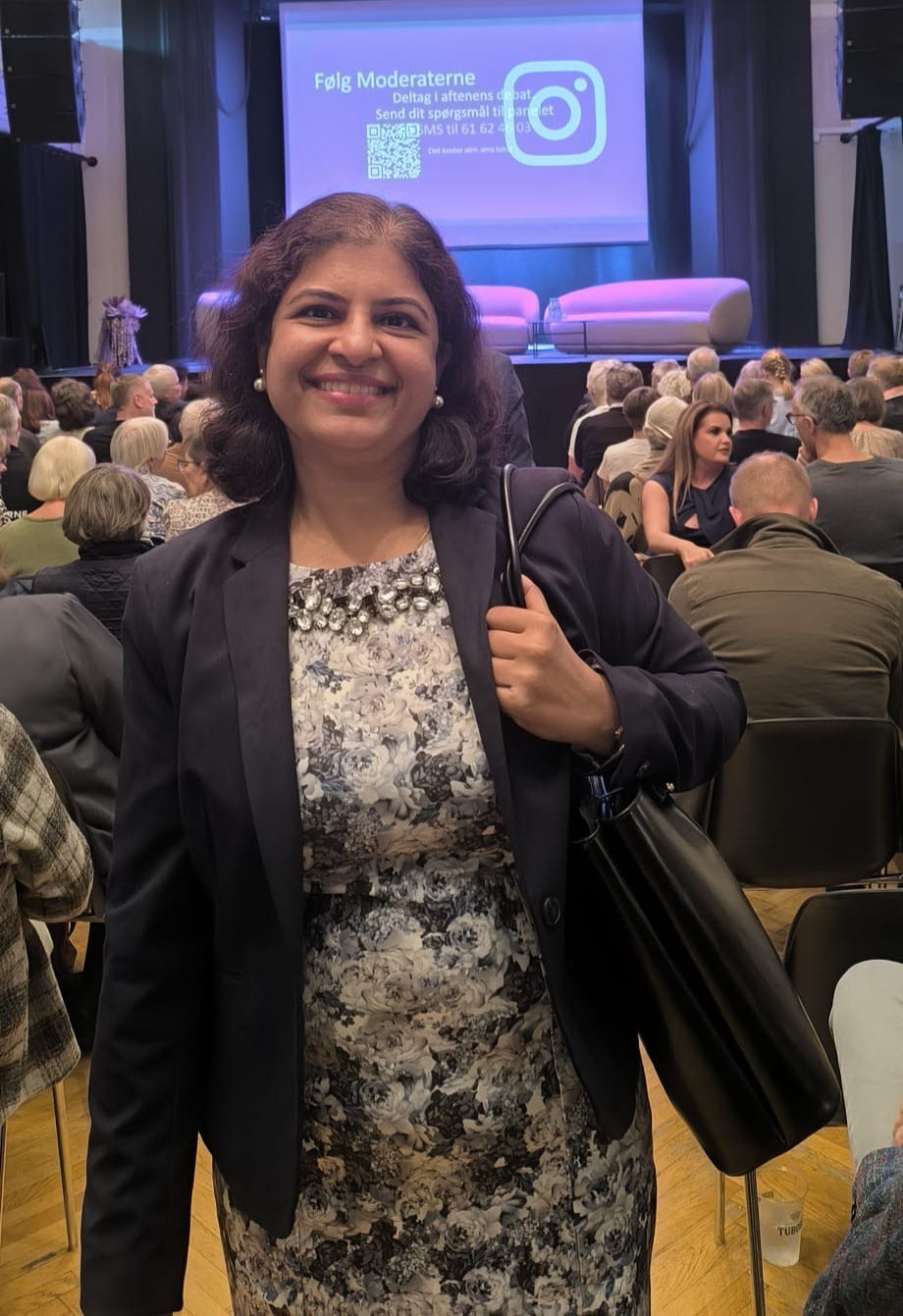
Smita has surprised people with her different approach to campaigning, focused on meeting people face to face. “In India, human relationships are much more important in politics than social media posts or TV debates,” she says. “You have to go on the road and meet the people. I’ve been told I’m more visible than some other candidates.”
“You’ll only see the diversity of Denmark if you meet people in person,” she says. “There are so many different types of immigrants here, and it’s important to hear what people’s lives are like and the issues they face. That will only come across if you meet people”
Increasing international turnout at elections is something Smita is determined to achieve. “Only around 65% of people voted in the last elections, and the missing voters are the internationals and those from minority ethnic groups,” she explains. “It’s very important - we have a democracy and the democratic system only works if people’s voices are heard. Staying away from the system will not change the system. You have to be in it. And how? You have to vote. Denmark is an open, transparent country. I try to tell people that whenever I meet them. The change can be you.”
Smita’s campaign is focused on improving the healthcare system, schools and living situations for the elderly. “Healthcare is vital. COVID taught us that,” she says. “This is an advanced country, so the healthcare should also be advanced. I understand the issues because I work in the system. There is waiting time, and people often have to travel long distances to have procedures carried out.” As the mother of a seven-year-old son, she would also like to see further improvements in schools, with teacher-pupil ratios lowered. For the elderly, she wants better regulations to improve daily life, including more affordable meals and better care homes.

Smita feels strongly that internationals have so much to offer Denmark. “We are coming here legally, contributing, giving 100%, so respect from both sides is important,” she says. She stresses that internationals also have responsibilities: “You cannot make a parallel system. If you are coming here, you have to be a part of the system. You come, you learn, and then you earn. I think it’s fair enough for Denmark to expect internationals to do that.” Smita doesn’t underestimate the challenges: “It is more difficult if you’re from a non-EU country. It takes time, and people can lose hope in that process, but one should not give up. It’s the system.” But her message is clear: everyone can integrate and have a successful life here.
She’d like to see changes to make the system easier to navigate, though: “There should be more guidance on how to integrate here. And more job opportunities. We should open the doors for people who want to be actively involved. We could be better at helping people to do that.”
Final thoughts
With such a busy day job, some might wonder how Smita will manage to juggle politics if she wins in November, but she has no doubts. “My husband always says, ‘You’re a smart woman and you’re very passionate!’” she says. “If I’m elected, it’s very important to me that I give 100%. And I have a lot of support from my family in that.”
Smita’s 7-year-old son has been an enthusiastic companion on the campaign trail! “If I have no childcare, I take him with me. He’ll say, ‘Are we going campaigning Mama?’ He’s so excited! He doesn’t understand politics and what I’m doing, but he likes going to different places, meeting and talking to people and seeing his mom doing something very active every day.”
And with that, Smita’s husband comes to remind her that she has to leave: she’s off to yet another event, meeting local people, shaking hands and listening to their stories. Every day is extremely busy, but she probably wouldn’t have it any other way!


